

10+ Years international experience

All document types supported

Fast processing & tracking

Worldwide delivery
How Apostille and Legalization Work in Bulgaria
If you need to use Bulgarian documents abroad, they must be officially validated so that foreign authorities can recognize them as legally valid. In most cases, this is done through an apostille in Bulgaria. If the destination country is not part of the Hague Apostille Convention, the document must go through legalization in Bulgaria, which involves additional embassy procedures.
Quick explanation:
- Apostille → for Hague Convention countries
- Legalization → for non-Hague countries
- Authority → depends on document type
This guide explains the full apostille and legalization process in Bulgaria in simple, practical terms. You will learn:
- which authority handles your document (Ministry of Justice, Regional Administration, NACID, or Ministry of Foreign Affairs)
- how long the process takes
- the typical apostille cost in Bulgaria
- when translation or pre-certification is required
- how legalization works for non-Hague countries
Bulgaria has been a member of the Hague Apostille Convention since 29 April 2001, but the system is not centralized. Different authorities handle different types of documents, and choosing the correct one is essential.
For clients, the most important point is simple: the correct authority depends on the document type. If you submit to the wrong institution, the process slows down immediately. That is why a country-specific service page matters. If you are searching for Apostille in Sofia, Apostille cost in Bulgaria, how to apostille documents in Bulgaria, or where to get apostille in Bulgaria, this page is designed to answer those exact questions.

Jabrayilova Ayshan
Consultant


Document samples
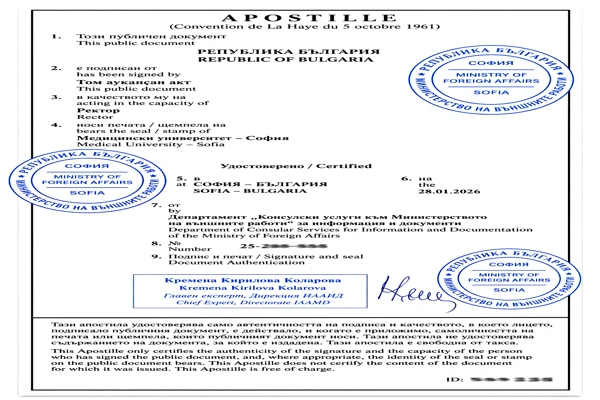
Sample Apostilled Document for Bulgaria
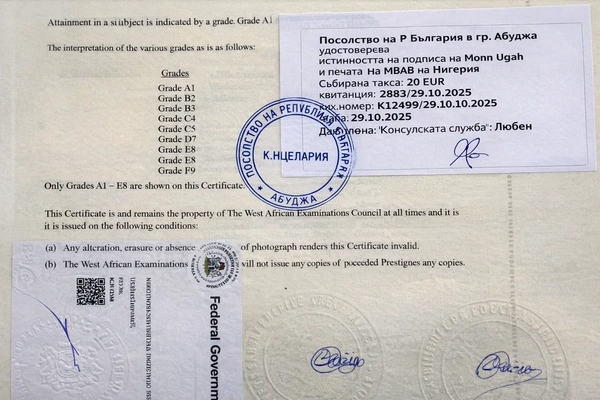
Sample Legalized Document for Bulgaria

EU Rule – When Apostille Is Not Required in Bulgaria
For many documents used between EU countries, apostille is not required. Under EU Regulation 2016/1191, certain public documents can be used across EU member states without apostille or legalization.
When Apostille Is NOT Needed in the EU: If your Bulgarian document is used in another EU country, apostille may not be required for:
- birth and death certificates
- marriage and divorce documents
- name and surname records
- residence and nationality certificates
- criminal record certificates
These documents can circulate within the EU without apostille, although translation may still be required.
How the EU Simplified System Works
EU Regulation 2016/1191 allows public documents issued in one EU country (like Bulgaria) to be accepted in another EU country without additional legalization.
✔ applies only between EU member states
✔ applies to documents issued by official authorities
✔ may require standard multilingual forms or certified translation
Important Limitations
- This rule does not apply to non-EU countries
- Some institutions may still request translation
- Not all document types are automatically covered
Always confirm with the receiving authority before skipping apostille.
Which Documents Can Be Apostilled in Bulgaria
In practice, Apostille Services in Bulgaria apply to a wide range of public documents.
These often include:
- birth certificates,
- marriage certificates,
- divorce certificates,
- death certificates,
- certificates of marital status or marriage capacity.
Education documents usually go through NACID. This includes:
- diplomas,
- certificates,
- transcripts,
- school and university education records,
- other academic proof used abroad.
NACID is the National Centre for Information and Documentation and is Bulgaria’s key institution for many education-related certification processes. Its official site lists both standard contact details and document certification guidance.
These include:
- court judgments,
- certificates issued by courts,
- enforcement-related documents,
- notarial acts,
- notarial certifications of signature, date, or content.
The Bulgarian Ministry of Justice confirms on its official apostille page that it certifies acts of courts and notaries.
Regional administrations apostille documents issued by mayors and municipal administrations. The Bulgarian administrative register states that the service “Issuance of Apostille certificate on documents issued by mayors and municipal administrations” is provided by the regional administrations, and the system lists 28 regional administrations.
Depending on the exact form and issuing authority, company and registry documents can also be certified for use abroad. In practice, corporate clients usually need apostille for:
- company registry extracts,
- certificates,
- powers of attorney,
- and certain commercial supporting documents issued by public authorities.
The Bulgarian Authority Map – Who Apostilles What
In Bulgaria, the authority that issues an apostille depends on the document type:
- Ministry of Foreign Affairs → legalization and international use
- Ministry of Justice → court and notarized documents
- Regional Administrations → civil and municipal documents
- NACID → educational documents

Ministry of Justice – Court and Notarial Documents
The Bulgarian Ministry of Justice issues apostilles for:
- court decisions and judicial documents
- нотариал acts (powers of attorney, declarations, нотариал deeds)
- certified signatures and official notarizations
Documents must usually be submitted in original or officially certified copies. Processing typically takes 3–5 working days, depending on volume.
Regional Administrations – Mayor and Municipal Documents
Regional administrations (28 regions across Bulgaria) apostille:
- birth, marriage, and death certificates
- municipal records and civil registry documents
Each region processes documents issued within its jurisdiction. Submitting to the wrong region may cause delays.
NACID – Education Documents
The National Centre for Information and Documentation (NACID) handles:
- diplomas and academic degrees
- school certificates
- educational transcripts
In most cases, documents must first go through pre-certification before apostille. This step is often required for international recognition.
Ministry of Foreign Affairs – Other Documents and Legalization
The Ministry of Foreign Affairs (MFA) is responsible for:
- full legalization procedures (for non-Hague countries)
- embassy and consular coordination
- final verification of documents for international use
If your destination country does not accept apostille, this step is mandatory.
How the Apostille Process Works in Bulgaria
If you are asking how to apostille documents in Bulgaria, the process usually follows these stages:

Confirm the Destination Country and Required Procedure
First, check where the Bulgarian document will be used. If the destination country is a member of the Hague Apostille Convention, the document usually needs an apostille in Bulgaria. If the country is not a Hague member, the document must go through legalization in Bulgaria, which is a longer process involving the Ministry of Foreign Affairs and, in many cases, the relevant embassy or consulate.
Identify the Correct Bulgarian Authority
The next step is to determine which Bulgarian authority handles your document type. In Bulgaria, the apostille authority depends on the category of the document:
- Ministry of Justice – court and notarial documents
- Regional Administrations – civil status and municipal documents
- NACID – educational documents
- Ministry of Foreign Affairs – legalization and certain international-use procedures
Submitting the document to the wrong institution is one of the most common reasons for delay.
Prepare the Document and Complete Submission
Prepare the original document or the acceptable certified form required by the relevant authority. In some cases, translation, pre-certification, or notarization may be needed before the apostille or legalization stage. After that, submit the document personally or through an authorized representative and pay the applicable state fee.
Receive the Apostilled or Legalized Document
Once the application is accepted, the authority processes the document according to its internal timeline. Some Bulgarian apostille procedures are completed within a few working days, while education and legalization procedures may take longer. After completion, the document is returned with the apostille certificate or with the legalization formalities completed for international use.
Apostille in Sofia, Plovdiv, and Varna
Quick answer:
Apostille services in Bulgaria are not centralized. The authority depends on the document type, not only the city:
- All cities → document type determines the final authority
- Sofia → central authorities (Ministry of Justice, NACID, MFA)
- Plovdiv / Varna → regional administrations for civil documents
Apostille in Sofia (Capital City – Main Authorities)
Sofia is the main hub for apostille and legalization in Bulgaria. Most central institutions are located here, including:
- the Ministry of Justice
- the National Centre for Information and Documentation (NACID)
- the Ministry of Foreign Affairs
This means that many apostille procedures, especially for:
- court and notarial documents
- educational documents
- international legalization cases
are handled directly in Sofia.
If your document requires legalization or complex verification, it will almost always pass through Sofia.
Apostille in Plovdiv (Regional Process)
In Plovdiv, apostille procedures usually follow a regional route:
- civil documents (birth, marriage, etc.) → Plovdiv Regional Administration
- court/notarial documents → Ministry of Justice (Sofia)
- education documents → NACID (Sofia)
Important note: Even if your document is issued in Plovdiv, it may still need to be processed in Sofia depending on the category.
Apostille in Varna (Regional + Central Combination)
Varna follows the same structure as other major regional cities:
- municipal and civil documents → Varna Regional Administration
- notarized or court documents → Ministry of Justice
- educational documents → NACID
For international use, documents may also require legalization through the Ministry of Foreign Affairs in Sofia.
NACID and Education Apostille in Bulgaria – Special Procedure Explained
Educational documents in Bulgaria follow a special apostille route through NACID, and often require pre-certification before apostille.
Why Education Documents Are Different in Bulgaria
Unlike civil or notarized documents, educational documents (such as diplomas and transcripts) are not processed directly for apostille. Instead, they must go through the National Centre for Information and Documentation (NACID), which:
- verifies the authenticity of educational documents
- confirms recognition status
- prepares documents for international use
This makes NACID a mandatory step before apostille in most education-related cases.
Step-by-Step: Education Apostille Process via NACID
- Document verification at NACID
The diploma or certificate is checked for authenticity and recognition. - Pre-certification stage
NACID may issue a confirmation or certification required before apostille. - Apostille issuance
After NACID, the document proceeds to the relevant authority for apostille. - Optional legalization (if required)
For non-Hague countries, the process continues through the Ministry of Foreign Affairs.
Electronic Submission for Education Documents
NACID offers electronic submission options, which can simplify the process in many cases.
Applicants may:
- submit documents online (where applicable)
- track the application status
- receive instructions for further steps
However, not all documents qualify for full online processing. Some cases still require physical submission or additional verification.
Is E-Apostille Available in Bulgaria? (Digital Apostille Explained)
Quick answer:
No, Bulgaria does not have a fully digital (e-apostille) system. Most apostille procedures still require physical documents and in-person or representative submission.
General Rule – Apostille in Bulgaria Is Not Fully Digital
Bulgaria has not implemented a unified e-apostille system across all authorities. In practice:
- original documents are usually required
- physical submission is standard
- apostilles are issued on paper documents
This means Bulgaria follows a traditional apostille process, not a fully digital one.
Exception – NACID and Education Documents
The only partial digitalization exists for education documents through NACID.
Applicants may:
- submit applications electronically
- receive instructions online
- track certain steps digitally
However, this is not a full e-apostille system, as physical verification and additional steps may still be required.
Online Verification of Apostilles in Bulgaria
Although issuance is not fully digital, Bulgaria provides online verification tools:
- Ministry of Justice → verification of court/notarial apostilles
- Ministry of Foreign Affairs → verification of legalization and related documents
These systems allow foreign authorities to confirm the authenticity of issued apostilles online.
Apostille Cost in Bulgaria – Quick Overview
The cost of an apostille in Bulgaria usually ranges between 5 BGN and 15 BGN per document, depending on the authority. Additional costs such as translation or legalization may apply.
Official Apostille Fees in Bulgaria (2026)
Typical government fees are:
- Ministry of Justice → 5 BGN
- Regional Administrations → 5 BGN
- NACID (electronic) → 7.5 BGN
- NACID (paper apostille) → 15 BGN
- Ministry of Foreign Affairs (legalization stage) → 15 BGN
These are official state fees and may vary slightly depending on updates.
Additional Costs to Consider
In most real cases, the total cost is higher due to:
- Translation → usually 10–20 BGN
- Notarization of translation → additional fee
- Pre-certification (education documents) → required in some cases
- Courier / representative services → optional but common
This means the total apostille cost in Bulgaria can vary depending on the document type and destination country.
Total Cost Estimate (Realistic Range)
| Document Type | Estimated Total Cost |
|---|---|
| Civil documents | 5 – 25 BGN |
| Notarial / court documents | 5 – 25 BGN |
| Education documents | 15 – 40+ BGN |
| Legalization (non-Hague countries) | 20 – 50+ BGN |
What Affects Apostille Cost in Bulgaria?
The final price depends on:
✔ urgency or additional services
✔ document type (civil, education, legal)
✔ authority involved (MoJ, NACID, MFA)
✔ destination country (apostille vs legalization)
✔ translation requirements
Processing Time for Apostille Services in Bulgaria
Apostille processing time in Bulgaria usually takes 3 to 5 working days, depending on the authority and document type. Some procedures may take longer, especially for education documents or legalization cases.
Typical Apostille Processing Times in Bulgaria
| Procedure | Processing Time |
|---|---|
| Ministry of Justice (court / notarial) | 3–5 working days |
| Regional Administration (civil documents) | 1–3 working days |
| NACID (education documents) | 5–10+ working days |
| Ministry of Foreign Affairs (legalization stage) | up to 8 working days |
Urgent Apostille in Bulgaria
Unlike some countries, official same-day apostille is not always guaranteed in Bulgaria.
However:
- some regional administrations may process faster
- low-volume submissions may be completed sooner
- using a representative can reduce delays
What Affects Processing Time?
The total timeline depends on:
- document type (civil, education, legal)
- authority involved (MoJ, NACID, MFA)
- workload of the institution
- need for translation or pre-certification
- legalization (non-Hague countries take longer)
Total Timeline
| Scenario | Estimated Time |
|---|---|
| Simple apostille (civil document) | 1–3 days |
| Notarial / court document | 3–5 days |
| Education document (NACID route) | 5–10+ days |
| Full legalization (non-Hague country) | 7–15+ days |
Important Note
Processing delays in Bulgaria usually happen due to: submitting to the wrong authority, missing pre-certification (education documents), incorrect translation requirements.
Embassies that perform legalization
Consular legalization is needed for documents used in non-Hague countries
Countries requiring consular legalization
Qatar
Kuwait
Saudi Arabia
Indonesia
Jordan
Libya
Iran
Lebanon
Sudan
Legalization Services in Bulgaria – For Non-Hague Countries
If the destination country is not a Hague Convention member, the document must go through Legalization Services in Bulgaria.
Processing Time and Cost
- MFA legalization stage → usually up to 8 working days
- State fee → approximately 15 BGN
- Embassy processing time → varies by country
- Translation → usually 10–20 BGN
Total time depends heavily on whether the embassy is located in Bulgaria or abroad.
Common Mistakes in Legalization
- not checking embassy location (causes major delays)
- skipping the correct initial authority
- incorrect translation format
- submitting to embassies without MFA certification
Step-by-Step Legalization Process in Bulgaria
Step 1 – Certification by the Competent Bulgarian Authority
TThe document must first be certified by the relevant Bulgarian authority, depending on its type:
- Ministry of Justice → court and notarial documents
- Regional Administration → civil documents
- NACID → educational documents
This step confirms the document is valid in Bulgaria.d copies. Processing typically takes 3–5 working days, depending on volume.
Step 2 – Legalization at the Ministry of Foreign Affairs (MFA)
After initial certification, the document is submitted to the Bulgarian Ministry of Foreign Affairs.
- MFA verifies the authenticity of the issuing authority
- Adds official legalization certification
- Prepares the document for international use
This is a mandatory step for all non-Hague countries. cause delays.
Step 3 – Embassy or Consulate Legalization
Once certified by the MFA, the document must be submitted to the embassy or consulate of the destination country.
Important:
If not → the document may need to be sent to another country (e.g., Turkey or Greece) often required for international recognition.
If the embassy is located in Bulgaria → process continues in Sofia
Step 4 – Translation and Notarization (If Required)
In most cases, documents must be:
- translated by an authorized translator
- notarized (translator’s signature certification)
Some embassies require translation before submission, while others accept it after legalization.

Common Problems and Apostille Rejection Risks in Bulgaria
The most common reasons for apostille rejection in Bulgaria include expired documents, incorrect authority submission, missing payment proof, and improper translations.
Expired or Outdated Documents
Some documents in Bulgaria have a limited practical validity period, even if they are officially valid. Common examples:
- criminal record certificates
- certificates of marital status or marriage capacity
These documents are often expected to be issued within the last 3–6 months. If the document is considered outdated, authorities may refuse to process it.
Missing Payment Proof
A frequent issue is submitting documents without proof of payment.
- some authorities require bank payment receipts
- others do not accept cash payments
- missing or incorrect payment confirmation can stop the process
Always verify the required payment method before submission.
Incorrect Authority Selection
Submitting documents to the wrong authority is one of the most common mistakes in Bulgaria. Examples:
- sending education documents directly for apostille without NACID
- submitting civil documents to the Ministry of Justice instead of regional administration
This leads to:
- rejection
- delays
- repeated submissions
Poor Appointment Planning
Some Bulgarian institutions require scheduled appointments. Common problems:
- booking too late
- missing available time slots
- arriving without prior reservation
This can delay the process by several days or more.
Start Your Apostille Process in Bulgaria Today
The fastest way to start your apostille process in Bulgaria is to identify the correct authority and submit complete information from the beginning.
What We Can Help You With
We provide full support for:
- Apostille services in Bulgaria
- Legalization services for non-Hague countries
- Bulgaria document legalization (end-to-end)
- Apostille in Sofia and all major cities
- Apostille for diplomas and education documents (NACID route)
- Apostille for birth, marriage, and civil certificates
- Apostille cost and process consultation
Send These Details to Get a Fast Response
To identify the correct procedure immediately, send:
- document type (e.g., diploma, birth certificate, power of attorney)
- destination country
- whether the document is for apostille or legalization
- document category (personal, educational, judicial, corporate)
With this information, the correct authority and process can be determined within minutes.
Start Now – Get Expert Guidance
Send your request now and receive:
- ✔ exact procedure for your document
- ✔ estimated processing time
- ✔ total cost breakdown
- ✔ step-by-step guidance
Response time: within 15–30 minutes (during working hours)
Start your Bulgaria apostille process today.
Avoid delays, choose the correct authority, and complete your document the right way. is the fastest way to identify the correct Bulgarian authority and avoid delays.
Read more:
FAQs
To apostille a birth certificate in Bulgaria, the document must first be issued by the civil registry and then submitted to the relevant regional administration. Processing usually takes 1–3 working days, depending on the region.
Educational documents in Bulgaria must go through NACID (National Centre for Information and Documentation)for verification before apostille. After pre-certification, the document proceeds to the appropriate authority.
In Bulgaria, the following documents can be apostilled:
- birth, marriage, and death certificates
- court and notarial documents
- diplomas and educational certificates
- company and corporate documents
👉 The authority depends on the document type.
Yes, apostille can be obtained through an authorized representative with a notarized power of attorney. This is a common solution for foreign clients.
In most cases, translation is not required before apostille, but it may be required:
- after apostille
- or during legalization procedures
Some authorities (especially for education documents) may have specific requirements.
Countries not part of the Hague Apostille Convention require legalization. Common examples include:
- United Arab Emirates
- Qatar
- Kuwait
- Saudi Arabia
These documents must go through embassy legalization procedures.