

10+ Years international experience

All document types supported

Fast processing & tracking

Worldwide delivery
Apostille in Romania: Full Process, Authorities and Legalization Rules
If you need apostille services in Romania for personal, educational, corporate, or court documents, understanding the official Romanian system is essential to avoid delays.
Whether you require a Romania document apostille for use in Germany, France, Italy, the United States, the United Kingdom, or Canada, or you need document legalization in Romania for non-Hague countries, the process depends on both the document type and the destination country.
Romania operates under a document-type-based authority system, meaning the institution responsible for issuing the apostille depends on the category of the document (judicial, notarial, or administrative). Many delays occur when documents are submitted to the wrong authority.
We provide apostille and legalization services across major cities including Bucharest, Cluj-Napoca, Iași, Timișoara, Constanța, as well as all regions of Romania.

Jabrayilova Ayshan
Consultant


Apostille and Legalization Document Samples in Romania
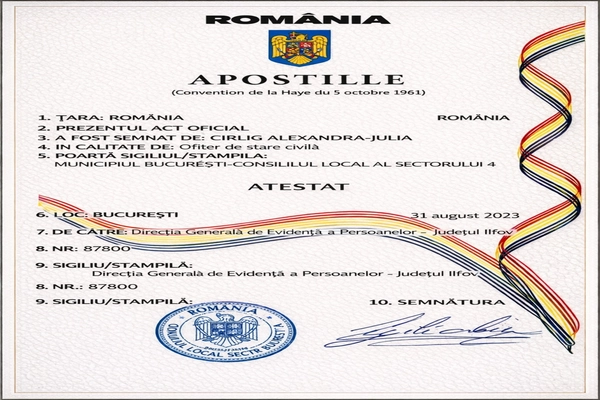
Sample Apostilled Document for Romania
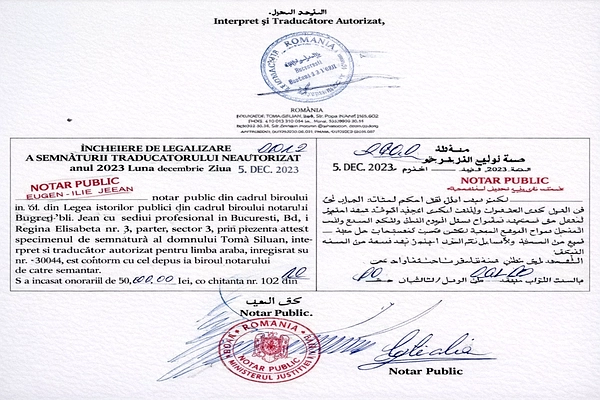
Sample Legalized Document for Romania

Legal Framework for Apostille in Romania
Romania joined the Hague Apostille Convention on 7 June 2000, and the Convention entered into force on 16 March 2001.
When Apostille or Legalization Is Required in Romania?
- If the destination country is a member of the Hague Convention → Apostille is required
- If the destination country is not a member → Consular legalization is required
Documents issued in Romania and apostilled under the Convention are recognized internationally without further legalization, making the process faster and more efficient.
Apostille Exemptions in Romania: EU Regulation and CIEC Documents
When Apostille Is Not Required in Romania
- EU Regulation 2016/1191
- CIEC multilingual civil status documents
EU Regulation 2016/1191 (EU-to-EU simplified use)
Under EU Regulation 2016/1191, certain public documents issued in Romania can be used in other EU Member States without an apostille.
This applies mainly to personal documents (such as birth, marriage, or residence certificates), which can circulate with reduced formalities. However, a translation may still be required depending on the receiving authority.
This regulation is especially relevant when Romanian documents are presented in another EU country.
CIEC Multilingual Civil Status Documents
(No legalization required in any form)
Documents issued under the CIEC multilingual format — including civil status certificates and certificates of no impediment to marriage — can be used internationally without apostille or legalization.
Whenever available, choosing the international multilingual version instead of a standard Romanian document can eliminate the entire legalization process.
Which Documents Can Be Apostilled in Romania
Many official documents issued in Romania can receive an apostille certificate, provided they are issued by a recognized authority and meet legal requirements.
The following personal documents are commonly eligible for apostille:
- Birth certificates
- Marriage certificates
- Death certificates
- Certificates of no impediment to marriage (including multilingual formats under CIEC)
- Criminal record certificates
- Adoption documents
Educational documents issued in Romania can also be apostilled, including:
- High school diplomas and transcripts
- University degrees and diploma supplements
- Enrollment certificates
- Academic records (grades and subjects)
Judicial documents can be apostilled if issued by competent authorities:
- Court decisions and rulings
- Bailiff documents (executor judecătoresc)
Business and property-related documents are frequently apostilled for international use:
- Extracts from the Romanian Trade Register
- Commercial registry documents (often processed via Bucharest Tribunal)
- Land register extracts
- Notarized powers of attorney
- Company documents notarized in Romania
Certain documents are not eligible for apostille under Romanian law:
- Trade contracts
- Invoices
- Customs documents
- Diplomatic or consular documents
- Romanian ID cards
Apostille Authorities in Romania – Who Issues Your Document?
In Romania, apostilles are issued by different authorities depending on the type of document. Choosing the correct authority is essential to avoid delays or rejection.

Type A – Judicial Documents (Apostille by Tribunals)
Judicial documents are apostilled by Romanian tribunals (tribunale). There are 42 tribunals across the country.
Typical Type A Documents
- Court decisions and rulings
- Documents issued by bailiffs (executor judecătoresc)
- Documents issued by the Commercial Registry Office
👉 In practice: The Bucharest Tribunal handles most Commercial Registry documents.
How to Get an Apostille from a Tribunal
- Identify the competent tribunal (based on issuing authority or location)
- Check working hours and submission requirements
- Submit the document in person (or via notarized power of attorney)
➡️ Apostille is often issued on the same day, depending on internal procedures.
Type B – Notarial Documents (Apostille by Chambers of Public Notaries)
Notarial documents are processed by the Chambers of Public Notaries. There are 15 regional chambers in Romania.
Typical Type B Documents
- Authentic notarial acts
- Documents with certified date (data certă)
- Documents with legalized signature
- Legalized translations (very important — many cases fall into this category)
How to Get an Apostille from a Notary Chamber
- Identify the competent chamber (usually based on where notarization took place)
- Prepare:
- Original document
- Valid ID (passport or ID card)
- Pay the apostille fee (often on-site)
- Complete the request form
➡️ Apostille is typically issued immediately after submission.
Type C – Administrative Documents (Apostille by Prefectures)
Administrative documents are apostilled by the Offices of the Prefect (42 institutions across Romania).
Typical Type C Documents
- Civil status documents (birth, marriage, death certificates)
- Name and family records
- Criminal records
- Tax and fiscal documents
- Educational documents (in many cases)
- Professional and employment records
- Religious documents
- Extracts from public registers
How to Get an Apostille from the Prefect’s Office
- Identify the competent prefect office
- Prepare:
- Original document
- ID
- Submit the request form
- If the document is not issued in your name → a power of attorney may be required
➡️ Apostille is often issued on the same day and may be free of charge for certain administrative documents.
Important Note
Some administrative documents may require prior certification by a competent Romanian authority (e.g., ministry or institution) before they can be apostilled.
This is especially common for:
- Educational documents
- Professional certifications
How to Get an Apostille in Romania (Step-by-Step Guide)
If you are wondering how to apostille documents in Romania, follow this clear step-by-step process:

Check the Destination Country
- If the destination country is a member of the Hague Convention → Apostille is required
- If not → Consular legalization is required instead
Identify the Document Category (A/B/C System)
Determine which type of document you have:
- Type A (Judicial) → Apostille issued by tribunals
- Type B (Notarial / translations) → Chambers of Public Notaries
- Type C (Administrative) → Prefect’s Office
Choosing the wrong category is the most common cause of delays.
Prepare and Submit Documents for Apostille
You will typically need:
- Original document (or certified copy, if accepted)
- Valid ID (passport or national ID card)
- Apostille request form (usually provided on-site)
- Proof of payment (if applicable)
- Notarized power of attorney (if applying through a representative)
Most apostille procedures in Romania require in-person submission. Alternatively, you can apply through a representative with a notarized POA.
Verify and Use the Apostilled Document Abroad
- Check the apostille details for accuracy
- When possible, verify the apostille via official registers
- Submit the document to the foreign authority
When Apostille Is NOT Required in Romania (EU Rules)
Romania is a member of the European Union, and in certain cases, apostille is not required for documents used within other EU countries.
According to EU Regulation 2016/1191, public documents such as birth certificates, marriage certificates, and criminal record extracts may be accepted without apostille if they are issued with a multilingual standard form or are recognized directly by the receiving authority. However, this rule applies only within EU member states and does not cover all types of documents. For example, commercial documents, powers of attorney, and corporate records often still require apostille even within the EU.
Before starting the apostille process in Romania, it is important to confirm whether your destination country accepts your document without apostille. This can save both time and unnecessary costs.
Documents That Cannot Be Apostilled in Romania
Not all documents issued in Romania are eligible for apostille. Submitting the wrong type of document is one of the most common reasons for rejection.
The following documents typically cannot be apostilled in Romania:
- Commercial invoices and informal business documents
- Documents without official signatures or stamps
- Private agreements that are not notarized
- Copies that have not been properly certified by a notary
- Documents issued by unauthorized institutions
In such cases, additional steps may be required, such as notarization, certification, or in some situations, full consular legalization instead of apostille. To avoid delays, it is essential to verify whether your document qualifies for apostille before starting the procedure.
Apostille Format and Verification in Romania
Understanding the apostille format in Romania and how to verify it helps applicants confirm that the document is valid for international use.
Apostille Format in Romania
In Romania, an apostille is issued as a square certificate attached to the document. It typically includes:
- the mandatory heading “Apostille”
- a reference to the 1961 Hague Convention in French
- sides measuring at least 9 cm
- the signature of the competent authority
- the official seal or stamp
- in many cases, a printed sticker or attached certificate with additional security elements, such as a hologram
Apostille Verification in Romania
Romanian apostilles, especially those issued for certain administrative documents, can often be verified through the official Romanian verification register.
Before using the document abroad, it is recommended to:
- check that all apostille details are clearly visible
- confirm that the issuing authority matches the document type
- verify the apostille in the official register whenever this option is available
This extra verification step can help prevent rejection by foreign authorities and confirm that the Romanian apostille is authentic.
Apostille Services in Romania by City: Bucharest, Cluj-Napoca & Iași
Apostille services in Romania vary by city depending on the type of document and the competent authority. The following locations are among the most important processing centers:
Apostille in Bucharest
Bucharest is the primary apostille hub in Romania, especially for complex and corporate-related documents.
Key reasons include:
- Multiple tribunals handling high-volume court and corporate cases
- The Bucharest Tribunal frequently processes Commercial Registry apostille requests
- The Ministry of Foreign Affairs (for legalization procedures) is located in Bucharest
This makes Bucharest the most important city for corporate, legal, and international document processing.
Apostille in Cluj-Napoca
Cluj-Napoca is a major education and business center, leading to high demand for apostille services.
Common apostille requests include:
- University diplomas and academic documents (often requiring additional verification steps)
- Corporate registry extracts
- Court decisions and legal documents
👉 This city is especially relevant for students, professionals, and business owners.
Apostille in Iași
Lași handles a wide range of apostille requests, particularly in the administrative and civil sector.
Typical cases include:
- Civil status documents (birth, marriage, death certificates)
- Education-related documents
- Administrative certificates
Lași is an important regional center for personal and administrative apostille services.
E-Apostille in Romania: Online Application Explained
Romania does not offer a universal e-apostille system for all document types. However, certain documents can be apostilled online under specific conditions.
Can You Get an Apostille Online in Romania? (E-Apostille Availability)
- Most apostille procedures are still handled in person
- A full online apostille system is not available for all documents
Online Apostille in Romania for Digital Documents (MAI HUB)
Certain electronically issued and digitally signed administrative documents can be apostilled online through the MAI HUB.
This applies only if:
- the document is issued in electronic format
- it contains a valid digital signature
Embassies for Consular Legalization in Romania
Consular legalization is required when documents are used in countries that are not part of the Hague Apostille Convention.
Examples of countries where legalization is often required include:
Countries requiring consular legalization
United Arab Emirates
Qatar
Kuwait
Malaysia
Jordan
Libya
Egypt
Iran
Lebanon
Sudan
Vietnam
When Do You Need Legalization in Romania?
If your destination country does not accept apostilles, you will need consular legalization in Romania. This applies to countries that are not members of the Hague Apostille Convention.
What Does Legalization in Romania Involve?
The consular legalization process typically includes the following steps:
- Pre-certification in Romania (depending on the document type)
- Legalization at Romania’s Ministry of Foreign Affairs in Bucharest
- Final legalization at the embassy or consulate of the destination country
(in Romania or, in some cases, in another country if no embassy is present in Bucharest)
Common Mistakes When Apostilling Documents in Romania
Although the apostille process in Romania is generally straightforward, many applications are delayed or rejected due to avoidable mistakes.
The most common issues include:
Submitting documents to the wrong authority
Different institutions issue apostilles depending on the document type (Prefect, Tribunal, or Notary Chamber). Choosing the wrong authority leads to immediate rejection.
Missing pre-certification or notarization
Certain documents must be notarized or certified before they can be apostilled. Skipping this step invalidates the application.
Using outdated civil documents
Older documents, especially those issued before the late 1990s, may not be accepted without reissuance or modernization.
Incorrect or incomplete translations
If a translation is required, it must be properly notarized. Errors in translation often result in refusal.
Avoiding these mistakes can significantly reduce processing time and ensure that your documents are accepted without complications.
Legalization Process in Romania for Non-Hague Countries
The consular legalization process in Romania involves several steps and authorities. Below is a clear step-by-step guide:
Pre-Certification in Romania
Depending on the document type, initial certification may be required by:
- Notaries (for notarized documents)
- Courts (for judicial documents)
- Relevant authorities (for administrative documents)
This step confirms that the document is officially issued and eligible for legalization.
In some cases, additional verification (such as institutional stamps or signatures) may be required.
Legalization at the Ministry of Foreign Affairs in Romania
Documents must be legalized by the
Ministry of Foreign Affairs in Bucharest.
- This step confirms the authenticity of the issuing authority
- Processing times and fees may vary depending on the document type
- In some cases, prior certification from another authority may be required before submission
Embassy or Consular Legalization
The final step is legalization at the embassy or consulate of the destination country.
- If the country has a resident embassy in Romania → the process is completed locally
- If not → legalization may need to be completed in another country
Important Situation: No Embassy in Romania
If the destination country does not have an embassy or consulate in Bucharest, you may need to:
- Complete legalization through a third country where diplomatic relations exist
- Or submit documents in the country where the embassy is located
This is a common situation for certain non-Hague countries.

How Much Does Apostille Cost and How Long Does It Take in Romania?
The cost and processing time for apostille services in Romania depend on the type of document and the issuing authority.
Apostille Fees in Romania by Document Type
Official fees in Romania are generally low compared to many countries, but they vary by authority:
| Document Category | Typical Fee |
|---|---|
| Notarial documents (Chambers of Notaries) | approx. 35 RON + VAT |
| Judicial documents (Tribunals) | approx. 20 RON |
| Administrative documents (Prefectures) | often free of charge |
Fees may vary slightly depending on the region and document specifics.
Apostille Processing Time in Romania
In most cases, apostille services in Romania are relatively fast:
- Many authorities issue apostilles on the same day
- Some cases may take 1–2 working days, depending on workload
Important Notes
- Processing time depends on the correct authority selection (A/B/C system)
- Delays usually occur when documents are submitted to the wrong institution
- Additional steps (such as translation or prior certification) may extend processing time

Translation Requirements for Apostille and Legalization in Romania
When preparing documents for international use, translation requirements are just as important as the apostille process.
Who Should Translate Your Documents?
You should use one of the following options:
- Sworn (authorized) translators in Romania
- Certified translators in the destination country (depending on the requirements of the receiving authority)
Always check what the receiving authority accepts before proceeding.
Do Translations Need an Apostille?
Short Answer:
Yes, in some cases — translations may also require an apostille.
Important Rule Many People Miss
If a document is:
- Translated in Romania
- And notarized by a Romanian notary
The translation becomes a Romanian public document. This means it may also require an apostille to be accepted abroad.
Practical Tip (Very Important)
If the destination country has strict requirements:
- It may be better to translate the document in the destination country
- This can help you avoid an additional apostille step for the translation

Apostille for Educational Documents in Romania (Vizare & Recognition)
Educational documents in Romania often require additional steps before apostille or legalization, especially for international use.
What Is “Vizare” (Pre-Certification)?
Before apostille or legalization, Romanian education documents may require “Vizare” (official certification/endorsement) from a competent authority.
Common Certification Authorities
- Pre-university documents (high school diplomas, transcripts)
→ County or School Inspectorate (Inspectoratul Școlar) - Higher education documents (Bachelor, Master, PhD diplomas)
→ Ministry of Education or relevant authority
This step confirms that the diploma is officially issued and valid.
Recognition and ENIC-NARIC Guidance
For international academic use, recognition frameworks may apply.
- Romania follows the ENIC-NARIC Network
- Some countries may request formal recognition procedures before accepting documents
CNRED Recognition Path (Higher Education)
For university-level documents, recognition may involve: CNRED (National Center for Recognition and Equivalence of Diplomas)
In some cases, CNRED certification is required before apostille or legalization, especially for study, work, or equivalence abroad.
Typical Safe Workflow for Educational Documents
To avoid rejection, the following step-by-step approach is commonly used:
- Authenticate pre-university documents via School Inspectorates
- Authenticate higher education diplomas via CNRED (if required)
- Apostille original documents through the Prefect Institution (when applicable)
- Translate documents through a sworn translator
- Notarize translations (if required)
- Apostille translations via the Chamber of Notaries
Important:
Many foreign authorities require:
- Apostille on the original document
- AND apostille on the translated/notarized version
This is why a layered process is often necessary.
Trusted Apostille Services in Romania
We provide structured and reliable apostille services in Romania for individuals and businesses worldwide. Our approach is focused on accuracy, compliance, and efficiency — helping you avoid delays, rejections, and unnecessary steps.
What Our Apostille Service Includes?
We support the full apostille and legalization process, including:
- Correct authority identification
(Tribunal, Prefect Institution, or Chamber of Notaries — based on your document type) - Document review and error prevention
(to avoid rejection due to incorrect formatting or missing steps) - Handling of judicial and corporate documents
(court decisions, bailiff documents, commercial registry extracts) - Educational document support
(including “Vizare” certification and CNRED pathways where required) - Consular legalization coordination
(for non-Hague countries requiring embassy legalization) - Certified translation support
(sworn translations aligned with destination country requirements) - Document procurement assistance
(re-issuance of lost, outdated, or damaged documents in Romania) - International courier delivery coordination
(secure global shipping of apostilled documents)
Service tone: We guide the process professionally and transparently, without unrealistic promises.
Why Work With Us?
- Clear guidance on the correct legal path (A/B/C system)
- Reduced risk of rejection or delays
- Support for complex and multi-step cases
- Experience with international document requirements
Our Service Approach
We guide each case professionally and transparently, without unrealistic promises. Every document is handled based on its specific legal requirements, not a one-size-fits-all approach.
Get Official Documents from Romania (Retrieval Services)
If your documents are lost, damaged, or outdated, we can assist with obtaining official replacements directly from Romanian authorities. This is especially useful for clients who are outside Romania or unable to apply in person.
What Documents We Can Obtain?
We provide support in obtaining:
- Civil status documents
(birth, marriage, death certificates) - Trade register extracts
(company records from the Romanian Trade Register) - Land register extracts
(property ownership and cadastral records) - Court documents
(decisions, rulings, and official case documents)
Additional Support
- Coordination with the relevant Romanian institutions
- Verification of document correctness before further processing
- International courier delivery of original documents
Start Your Apostille Process in Romania Today
If you need help with:
- Apostille services in Romania
- Consular legalization for non-Hague countries
- Romania document apostille and certification
- Step-by-step guidance for the apostille process
- Apostille support in Bucharest, Cluj-Napoca, Iași, or other regions
- Clear information about apostille costs and requirements
We can guide you through the correct process from start to finish.
Why This Service Matters
Many apostille and legalization cases are delayed or rejected because:
- Documents are outdated or invalid
- Incorrect versions are submitted
- Required originals are missing
We help ensure your documents are correct, complete, and ready for apostille or legalization – avoiding unnecessary delays.
Get Started in 3 Simple Steps
- Contact us through our website
- Upload your scanned documents
- Tell us your location (Bucharest, Cluj-Napoca, Iași, or other)
📞 You will receive a response within 1 business day with clear next steps.
Request Apostille Services Now!
Read more:
FAQs
An apostille in Romania is an official certification issued under the Hague Convention that confirms the authenticity of a document for use abroad. It verifies the signature, seal, or stamp on Romanian public documents so they can be accepted in other member countries without additional legalization.
You need consular legalization if the destination country is not a member of the Hague Apostille Convention. In this case, documents must go through multiple steps, including the Ministry of Foreign Affairs and the embassy of the destination country.
The apostille process in Romania usually takes 1 to 5 working days, depending on the authority and document type. Some tribunals issue apostilles on the same day, while commercial documents processed through Chambers of Commerce may take longer.
Yes, foreigners can obtain an apostille in Romania by appointing a local representative with a notarized power of attorney (POA). This is a common solution for international clients who want to avoid travel and speed up the process.
Yes, in most cases. Romanian birth certificates typically need to be apostilled when used outside the EU or in countries that require formal document validation.
For use within the EU, an apostille may not be required under EU Regulation 2016/1191, but translation may still be necessary.
It depends on the destination country.
- In many cases, documents are apostilled in their original language first
- Translation is then done afterward and may also require notarization and apostille
Requirements vary, so it is important to follow the correct sequence.
Yes, in most cases. Romanian educational documents often require:
- Pre-certification (“Vizare”)
- Possible recognition through CNRED
- Apostille of the original document
Additional steps depend on the destination country and purpose.
In most cases, no. Romanian authorities usually require the original document for apostille. However, there are exceptions:
- A certified copy issued by a notary may be accepted
- In such cases, the apostille is applied to the notarial certification, not the original document
This is commonly used when the original document cannot be submitted.