

10+ Years international experience

All document types supported

Fast processing & tracking

Worldwide delivery
Document Legalization in the UAE: Attestation Process for Personal, Educational, and Corporate Documents
Documents issued in the United Arab Emirates often need official authentication before they can be used in another country. This process confirms that the document is genuine and legally valid for international authorities. Unlike many countries, the United Arab Emirates is not a member of the Hague Apostille Convention. Because of this, the apostille procedure does not apply to documents issued in the UAE. Instead, documents must go through consular legalization, also known as document attestation.
Legalization ensures that the document has been verified by the relevant authorities in the UAE before it is accepted abroad. This process usually involves several steps including notarization, authentication by government authorities, and legalization by the embassy of the destination country.

Jabrayilova Ayshan
Consultant


Hague Apostille Convention Status of the United Arab Emirates
The United Arab Emirates has not joined the Hague Apostille Convention.
This means:
- Apostille certificates are not issued in the UAE
- Apostille certificates from other countries are not automatically accepted
- Documents must go through full consular legalization
As a result, all documents intended for international use must follow the attestation process through official UAE authorities. This rule applies to both personal documents and corporate documents.
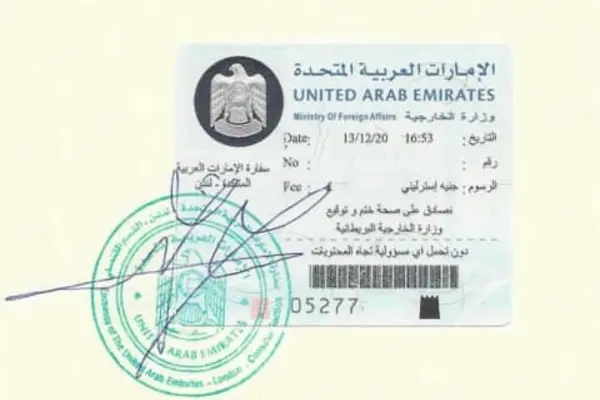
Sample Legalized Document for the United Arab Emirates (UAE)

Why Apostille Is Not Used in the UAE
The apostille system works only between countries that are members of the 1961 Hague Convention Abolishing the Requirement of Legalisation for Foreign Public Documents. Since the UAE has not joined the convention, apostille certification cannot be issued by UAE authorities.
Instead, documents must undergo a multi-stage legalization process, which includes verification by government authorities and consular confirmation.
This process ensures that foreign governments can trust the authenticity of documents issued in the UAE.
Legalization of Documents in the United Arab Emirates
Legalization is the official process used to authenticate documents for international use. In the UAE, legalization usually involves the following stages:
- Notarization of the document
- Verification by the Ministry of Justice (if required)
- Authentication by the Ministry of Foreign Affairs
- Legalization by the embassy or consulate of the destination country
This procedure confirms that the document is valid and issued by the appropriate authority.
Types of Documents That Require Legalization in the UAE
Many types of documents may require legalization when they are intended for use outside the UAE. These documents generally fall into three categories: personal documents, educational documents, and corporate documents.
Personal documents are among the most commonly legalized documents. Examples include:
- birth certificates
- marriage certificates
- divorce certificates
- death certificates
- police clearance certificates
These documents are frequently required for immigration, marriage registration abroad, or residency applications.
Educational certificates issued in the UAE may also require legalization before they can be used abroad. Typical examples include:
- university diplomas
- academic transcripts
- school certificates
- professional qualification certificates
Students applying to universities abroad often need legalized academic documents..
Companies operating internationally may also need to legalize corporate documents. Examples include:
- certificates of incorporation
- commercial licenses
- board resolutions
- powers of attorney
- contracts and agreements
These documents are often required when opening foreign bank accounts, establishing branches, or signing international contracts. These documents may be required in international litigation, immigration cases, or legal recognition procedures.visas, or inheritance procedures.
Government Authorities Responsible for Legalization in the UAE
Official Authorities for Document Legalization in the United Arab Emirates
In the UAE, document legalization is handled by government institutions responsible for verification, notarization, and international authentication. Choosing the correct authority is essential to avoid delays or rejection.

Ministry of Foreign Affairs
Final Authority for Document Legalization in the UAE
The Ministry of Foreign Affairs UAE is the final and mandatory authority for document legalization in the UAE. All documents must be attested by MOFA before they are accepted internationally.
Main functions:
- Attestation of documents for international use
- Verification of previous legalization steps
- Final approval before embassy submission (if required)
Key locations (GEO optimized):
- Dubai: Al Qusais 1, Consulate Area
- Abu Dhabi: King Abdullah Bin Abdulaziz Al Saud Street
Official website: mofa.gov.ae
Phone: +971 800 44444
Working hours:
Monday – Friday: 08:00 – 15:00
Digital service:
MOFA legalization services are available via the UAEMOFA mobile application.
Ministry of Justice
Authority for Notarization and Legal Certification
The Ministry of Justice UAE is responsible for notary services and legal certification, which are required before proceeding to MOFA legalization.
Main functions:
- Notarization of documents
- Certification of translations
- Legal validation of contracts and declarations
Official website: moj.gov.ae
Email: info@moj.gov.ae
Phone: +971 600 522222
Working hours:
Monday – Thursday: 07:30 – 15:30
Friday: 07:30 – 12:00
Central address:
P.O. Box 393, Abu Dhabi, UAE
Legalization Procedure in the UAE
The legalization process in the UAE has been modernized and many steps can now be completed online. However, the general procedure usually includes several stages.

Notarial Certification
Notarize the Document in the UAE
The legalization process in the UAE usually starts with notarial certification if the document requires it. This step confirms that the document, signature, copy, translation, or declaration is formally acceptable for further legalization.
Documents commonly requiring notarization include:
- Powers of attorney
- Declarations and affidavits
- Certified copies
- Some translated documents
- Certain commercial documents
Important:
If notarization is required and skipped, the document may be rejected at the next stage.
Practical note:
Notarial procedures in the UAE may be completed through approved notary channels, depending on the document type and emirate.
Authentication by the UAE Ministry of Foreign Affairs
After notarization, the document is usually submitted to the UAE Ministry of Foreign Affairs (MOFA) for official authentication. This is the main legalization step for documents intended for use outside the UAE.
MOFA authentication confirms:
- The document has passed the required prior step
- The signature or certification is recognized
- The document is ready for international use
Common use cases:
- Birth and marriage certificates
- Educational certificates
- Corporate documents
- Powers of attorney
- Court-related and personal documents
Important:
Processing time and fees may vary depending on whether the document is personal, educational, or commercial.
Embassy or Consulate Legalization
Final Legalization by the Destination Country Embassy
If the destination country requires consular legalization, the final step is submission to the embassy or consulate of the receiving country in the UAE.
This stage confirms that the document will be accepted in that specific country.
At this stage, the embassy or consulate may check:
- The MOFA authentication
- Document type and purpose
- Translation requirements
- Additional country-specific conditions
Important:
Each embassy may have its own rules, document list, fees, and timing.
Electronic Legalization System in the UAE
Although apostille services do not exist in the UAE, the country offers an advanced electronic attestation system. Applicants can submit legalization requests through the Attestation of Official Documents and Certificates service. The procedure usually includes the following steps:
- Access the MOFA service portal
- Verify identity using UAE PASS
- Upload documents for attestation
- Pay government fees online
- Receive confirmation notification
Applicants can also request courier delivery of legalized documents within the UAE.For these types of documents, Legalization Services in Argentina must be used instead of apostille certification.
Legalization Process for Foreign Clients in UAE
Foreign clients who need to legalize documents in the UAE should understand that many procedures require UAE PASS digital identity verification. The legalization process is primarily completed online. Applicants must:
- register in the UAE PASS system
- verify their identity
- submit documents electronically
- pay government fees
- receive documents via courier
This digital system simplifies procedures but may require physical presence in the UAE to activate digital identity.
Digital Identity Requirement – UAE PASS
One of the most important elements of UAE government services is UAE PASS, which functions as a digital identity system. Without an active UAE PASS account, many electronic services cannot be accessed. To activate UAE PASS, individuals may need:
- Emirates ID
- biometric verification
- registration through official kiosks
Because of this requirement, international clients sometimes work with local representatives when legalizing documents.
Embassies that perform legalization
Consular legalization is needed for documents used in non-Hague countries
Countries requiring consular legalization
Afghanistan
Qatar
Kuwait
Saudi Arabia
Indonesia
Malaysia
Jordan
Libya
Ethiopia
Egypt
Iran
Lebanon
Sudan
Vietnam
Common Challenges in the UAE Legalization Process
Although the UAE has advanced digital services, certain practical challenges may occur. These include:
- lack of UAE PASS digital identity
- translation requirements into Arabic
- embassy-specific legalization procedures
- courier delivery limitations outside the UAE
Additionally, many authorities require both the original document and the Arabic translation before legalization can proceed. Proper preparation of documents can significantly reduce delays.Because multiple institutions are involved, legalization procedures usually take longer than apostille certification.

Typical Processing Time for Legalization in the UAE
How Long Does Legalization Take in the UAE?
Processing time for document legalization in the United Arab Emirates depends on the document type, authority involved, and urgency level. In most cases, the process can be completed within a few days if all documents are correctly prepared.
Legalization Processing Timeline in the UAE
| Procedure | Typical Processing Time |
|---|---|
| Notarial certification | Same day |
| Ministry of Justice (if required) | Same day – 1 business day |
| MOFA attestation (UAE) | 0 – 3 business days |
| Embassy legalization | 1 – 5 business days |

Translation Requirements for Legalization
Documents submitted for legalization may need to be translated. In the UAE, translations must often be completed by translators certified by the Ministry of Justice.
Important rules include:
- documents must usually be in Arabic or English
- translations must be performed by licensed translators
- translations may require official certification
Translation requests can be submitted online through the Ministry of Justice portal:
After authentication, translated documents can be submitted for legalization.

Practical Uses of Legalized Documents from the UAE
Legalized documents issued in the UAE are commonly used for:
- immigration procedures
- international business registration
- property transactions abroad
- academic applications
- international marriage registration
- foreign employment
Proper legalization ensures that foreign authorities accept the document without additional verification.
Conclusion – Legalizing Documents from the United Arab Emirates
Do You Need Apostille or Legalization in the UAE?
The United Arab Emirates is not a member of the Hague Apostille Convention, which means apostille is not available. All documents intended for use abroad must go through the full legalization process.
The standard legalization chain in the UAE includes:
- Notarial certification (if required)
- Authentication by the Ministry of Foreign Affairs (MOFA)
- Legalization by the embassy or consulate of the destination country
Important:
Each step is mandatory, and skipping any stage may result in rejection of the document.
Read more:
Frequently Asked Questions About UAE Document Legalization
No, the United Arab Emirates does not issue apostille certificates because it is not part of the Hague Apostille Convention. Instead, documents must go through the full legalization process for international use.
To legalize documents in the UAE, you must follow these steps:
- Notarization (if required)
- Ministry of Justice certification (if applicable)
- Ministry of Foreign Affairs (MOFA) attestation
- Embassy legalization of the destination country
Skipping any step may result in rejection.
Legalization costs in the UAE depend on the document type:
- Personal documents: usually around 150 AED (MOFA fee)
- Commercial documents: can reach 2000 AED or more
Additional costs may include notary, translation, and courier services. fees may apply for notarization and embassy legalization.
Legalization in the UAE usually takes:
- MOFA attestation: same day to 3 business days
- Full legalization (including embassy): 2 to 7 business days
Processing time may vary depending on the embassy and document type.
You can legalize documents in:
- Dubai (Al Qusais MOFA office)
- Abu Dhabi (MOFA headquarters)
Notarization is handled through Ministry of Justice systems and authorized notary offices. time may vary depending on the embassy and document type.
Yes, in many cases documents must be translated into the language of the destination country before embassy legalization. Translations usually need to be certified or notarized. time may vary depending on the embassy and document type.
Yes, legalization in the UAE can be completed through an authorized representative or service provider. This is common for foreign clients who are outside the UAE.
- Apostille → used in Hague Convention countries (not applicable in UAE)
- Legalization → required for UAE documents for international use
In the UAE, only legalization is available, not apostille.