


10+ Years international experience

All document types supported

Fast processing & tracking

Worldwide delivery
10+ Years experience
All document types
Fast processing
Worldwide delivery
Apostille in Russia – Legalization Requirements & Timeline
If you intend to use official Russian documents abroad, they must be formally recognized in the destination country. In most cases, this recognition is obtained through Apostille Services in Russia. However, for countries that are not members of the Hague Convention, you will need Legalization Services in Russia, also known as consular legalization or embassy attestation.
This in-depth guide explains:
- The legal basis for apostille in Russia
- Which documents can and cannot be apostilled
- The competent authorities (Ministry of Justice, MVD, Archives, Education bodies, etc.)
- Regional jurisdiction rules
- Apostille cost in Russia
- Processing timeframes
- Educational document legalization
- Consular legalization routes (MFA and Chamber of Commerce)
- Minsk Convention exemptions
- Practical risks and refusal reasons
- How to start Russia Document Apostille correctly
Whether you need Apostille in Moscow, Saint Petersburg, or any other region of the Russian Federation, understanding the structure of the system is essential.

Jabrayilova Ayshan
Consultant


Document samples
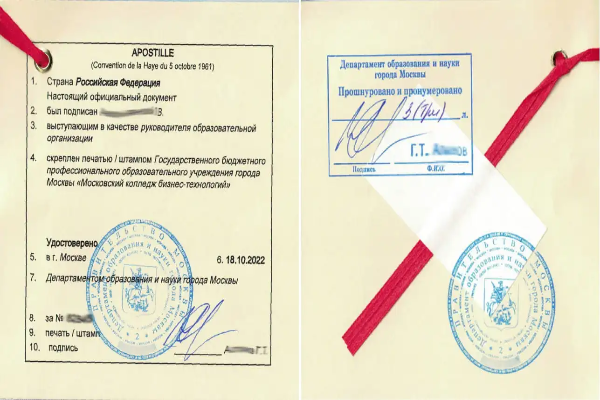
Sample Apostilled Document for Russia
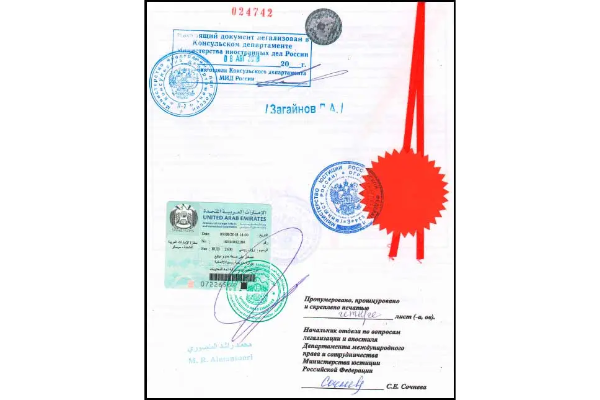
Sample Legalized Document for Russia

Legal Basis for Apostille Services in Russia
Russia joined the Hague Convention Abolishing the Requirement of Legalization for Foreign Public Documents on 6 December 2001.
This means:
- If your destination country is a Hague Convention member → Apostille is required and sufficient.
- If the destination country is not a Hague member → Consular legalization is required.
More than 120 countries are members of the Hague Apostille Convention.
What Apostille Replaces
Before the Hague Convention, documents required full diplomatic legalization through multiple government bodies and embassies. Apostille simplifies this to a single certification issued by the competent authority in the issuing country.
Important Clarification on Dates
Some online sources reference earlier participation dates. However, for practical purposes, what matters is that Russia currently applies the Hague Apostille system, and documents between Hague member states can be certified with apostille instead of diplomatic legalization.
What Is an Apostille in Russia?
An apostille is an official certificate that verifies:
- The authenticity of the signature
- The capacity of the person signing the document
- The authenticity of the seal or stamp
It does not verify the content of the document — only its formal authenticity.
Apostille vs Legalization – Legal Difference in Practice
Understanding the legal distinction is critical for international use.
| Feature | Apostille | Consular Legalization |
|---|---|---|
| Applicable Countries | Hague Convention members | Non-Hague countries |
| Number of Stages | One main authority | Multiple authorities + embassy |
| Complexity | Moderate | High |
| Embassy Step | Not required | Required |
| Time | Faster | Longer |
When Legalization Overrides Apostille
If the destination country does not recognize the Hague Convention, apostille is insufficient. The document must go through full consular legalization. Additionally, bilateral or multilateral treaties (such as the Minsk Convention) may override apostille requirements.
Documents That Can Be Apostilled in Russia
The Hague Convention applies primarily to public documents issued by government authorities.
- Birth certificate
- Marriage certificate
- Divorce certificate
- Death certificate
- Single status certificate
- High school diploma
- University degree
- Academic transcript
- Enrollment certificate
- Judicial decisions
- Court rulings
Typical Use Cases
- Marriage with foreign citizen
- International court proceedings
- Taking a child abroad
- Powers of attorney
- Declarations
- Inheritance certificates
- Extracts from commercial register
- Company registration certificates
- Tax registration documents
Authorities Responsible for Apostille in Russia
A key feature of the apostille process in Russia is that it is decentralized and depends on the type of document. Different authorities are responsible for issuing apostilles based on the category and origin of the document.

Ministry of Justice (Primary Authority)
The Ministry of Justice of Russia is the main authority responsible for apostille services for most public and notarial documents. It operates through regional offices across the country, ensuring documents are properly certified for international use.
Address: 14 Zhitnaya Ulitsa, Moscow 119991
Website: http://www.minjust.ru
The Ministry of Internal Affairs handles documents related to criminal records and administrative offenses. These documents must be verified by the MVD before they can proceed for apostille.
Prosecutor’s Office
Documents issued by prosecution authorities are processed through the competent prosecutor’s office. These may include official legal records required for international legal or administrative procedures.
Federal Archival Agency
Documents obtained from archives, including historical records and older official certificates, must be processed through the Federal Archival Agency before apostille can be applied.
Ministry of Defence
Military-related documents, such as service records and certificates, are handled by the Ministry of Defence. These documents require proper verification before being prepared for international use.
Regional Education Authorities
Educational documents such as diplomas, transcripts, and academic certificates are verified by regional education authorities. These institutions confirm authenticity before apostille is issued.
Civil Registry Offices (Registries
Civil status documents, including birth, marriage, divorce, and death certificates, are issued by registry offices. These documents must be submitted to the appropriate authority for apostille depending on their use abroad.
Step-by-Step Apostille Process in Russia
If you need to apostille a document in Russia, it is important to follow the correct steps. The process depends on the destination country, document type, and authority responsible.

Identify Destination Country
Before starting the apostille process, confirm where the document will be used.
- Hague Convention country → apostille is required
- Non-Hague country → consular legalization is required
- Minsk Convention countries → in some cases, no legalization is needed
Always check the specific requirements of the receiving country.
Identify Correct Authority
Choosing the correct authority is essential. Submitting documents to the wrong authority may lead to rejection or delays.
Examples:
- Criminal record certificate → Ministry of Internal Affairs (MVD)
- Diploma or academic records → Regional education authority
- Court documents → Ministry of Justice (regional office)
Prepare Required Documents
Make sure all documents are complete and meet the requirements before submission.
Typically required:
- Valid ID document
- Original document or certified copy
- Payment receipt for the state fee
- Notarized power of attorney (if a representative applies)
Incomplete documents may cause delays.
Translation Requirements
If your document is not in Russian, a notarized translation is usually required.
- Translation must be accurate and properly certified
- In some cases, the translation also needs apostille or legalization
- Estimated translation cost: 1,700–2,400 RUB per document
Requirements may vary depending on the destination country.
Issuance Timeline
Processing time depends on the document type and verification process.
- Standard processing: up to 5–7 working days
- If verification is required: up to 30 working days
- Educational documents: up to 30–45 days
Note: express service is generally not available.
Territorial Rule – Apostille in Russia Is Region-Based
One of the most important practical rules in the apostille process in Russia is territorial jurisdiction. In most cases, documents can only be apostilled in the region where they were originally issued. Submitting documents to a different region may result in rejection or significant delays. This rule is especially important for the following document types:
- Educational documents (diplomas, certificates)
- Archive records and historical documents
- Criminal record certificates
Practical tip: Always check the issuing region of your document before applying for apostille to avoid unnecessary delays.
Apostille Cost in Russia
The cost of apostille services in Russia depends on both official state fees and additional service expenses.
Official State Fee
The standard state fee for apostille in Russia is:
- 2,500 RUB per document
This fee is fixed and paid to the competent authority.
Additional Costs
In practice, the total cost may include extra services depending on your case:
- Notarized translation (if the document is in a foreign language)
- Notary certification fees
- Courier or international delivery services
- Representation or processing services (if you apply through a service provider)
Documents Not Subject to Apostille
Not all documents can be apostilled in Russia. Certain document types are excluded from the apostille process under national rules or international practice.
Documents That Cannot Be Apostilled
The following documents are generally not eligible for apostille:
- Documents that contradict Russian legislation
- Employment records
- Military identification documents
- Internal identity cards
- Diplomatic and consular documents
- Customs-related documents
E-Apostille in Russia
Currently, e-apostille (electronic apostille) is not available in Russia. All apostille procedures are carried out in physical format through the competent authorities.
Embassies that perform legalization
Consular legalization is needed for documents used in non-Hague countries
Countries requiring consular legalization
United Arab Emirates
Qatar
Kuwait
Saudi Arabia
Indonesia
Malaysia
Jordan
Libya
Ethiopia
Egypt
Iran
Lebanon
Sudan
Vietnam
Legalization Services in Russia (Consular Legalization)
If apostille cannot be used (for example, for countries like UAE, China, or Qatar), documents must go through consular legalization in Russia. This is a multi-step process involving several authorities. There are two main legalization routes depending on the document type:
There are two routes:
Route 1 – Ministry of Foreign Affairs (MFA Route)
This is the most common procedure for personal, legal, and official documents.
Step-by-Step Process
- Notarized copy of the document
- Notarized translation (if required)
- Legalization at the Ministry of Justice of Russia
- Legalization at the Ministry of Foreign Affairs (MFA)
- Final certification at the embassy of the destination country
Route 2 – Chamber of Commerce Route (Commercial Documents)
This route applies to business and trade-related documents.
Common Documents:
- Certificates of origin
- Commercial invoices
- Agency or distribution agreements
Step-by-Step Process:
- Certification by the Chamber of Commerce
- Legalization at the embassy of the destination country
Embassies Requiring Legalization in Russia – Which Countries and How the Process Is Regulated
When a destination country is not a member of the Hague Convention, documents issued in Russia must go through consular legalization. The final and mandatory stage of this procedure takes place at the embassy or consulate of the destination country in Russia.
This means that after certification by the competent Russian authorities and the Ministry of Foreign Affairs, the document must be submitted to the diplomatic mission of the country where it will be used.
Which Countries Require Consular Legalization in Russia?
In general, legalization is required for countries that:
- Are not members of the Hague Convention, or
- Have special internal requirements despite being Hague members, or
- Do not recognize apostilles for specific document types
⚠️ Important: Requirements may change. Some countries may accept apostille but still require additional certification for commercial or education documents. Therefore, verification must always be done case-by-case.
How Is the Legalization Process Regulated in Russia?
Legalization in Russia is regulated through a structured multi-stage procedure:
Notarial Certification
If required, the document must first be notarized.
This may include:
- Preparation of a notarized copy
- Notarized translation (if the document is in a foreign language)
This step ensures the document is legally valid for further certification.
Ministry of Justice Certification
The document is submitted to the Ministry of Justice (or another competent authority depending on the document type).
At this stage:
The document is officially certified for international use
The authenticity of the notary’s signature is verified
Ministry of Foreign Affairs (MFA) Legalization
The Ministry of Foreign Affairs confirms the authenticity of the previous certification.
This step:
Prepares the document for submission to foreign authorities
Validates the Ministry of Justice seal
Embassy or Consular Legalization
The document is submitted to the embassy or consulate of the destination country located in Russia.
Each embassy applies:
- Its own fees
- Its own appointment system
- Its own document format requirements
- Its own processing timelines
Processing: express service is generally not available.
Legalization Services in Russia (Consular Legalization)
Where Does Embassy Legalization Take Place?
Most embassies requiring legalization are located in Moscow, as Moscow hosts the majority of diplomatic missions accredited in Russia.
In some cases:
- Certain countries operate consulates in Saint Petersburg or other regions.
- Some countries require documents to be submitted only through specific authorized agencies.
- Some embassies require prior registration through online portals.
Legalization via the Chamber of Commerce (Commercial Documents)
For commercial documents such as:
- Certificates of origin
- Invoices
- Agency agreements
- Corporate documents
Legalization may be processed through:
- Certification at the Chamber of Commerce and Industry
- Certification at the destination country’s embassy
This route is commonly used for trade-related documentation.
Common Reasons for Embassy Refusal
Embassy legalization may be refused if:
- Translation is incorrect or incomplete
- Ministry-level certification is missing
- The document is damaged or outdated
- The wrong legalization route was followed
- The document contradicts Russian law

Apostille Fees and Processing Time in Russia
The cost of Apostille certification in Russia is regulated by the state and may vary slightly depending on the region and additional services required.
Standard Apostille Service in Russia
| Document type | Fee |
|---|---|
| Non-commercial documents | 2,500 RUB per document |
| Commercial documents | 2,500 RUB per document |
In Russia, the state fee for Apostille is generally fixed regardless of document type.
Standard processing typically takes around 4 working days.
Processing Time:
Standard processing usually takes 3 to 5 working days, depending on the authority and region where the document was issued.
Express Apostille Service in Russia
Expedited Apostille services may be available in some regions through authorized representatives or agencies. Express Apostille → 1–2 working days → Additional service fees apply (varies by provider)
Important: There is no official government fast-track fee.
Additional Costs to Consider
- Notary certification (if required)
- Certified translation
- Courier or delivery services
- Legal representation (for foreign applicants)
Practical Note for Foreign Clients: Foreign applicants usually need a local representative in Russia to handle the Apostille process, as remote applications are limited.

Language and Translation Requirements for Apostille in Russia
Documents intended for international use from Russia must comply with the language requirements of the destination country. In most cases, proper translation is a key step before or after Apostille certification
Translation Rules in Russia
IIn practice, the following rules apply:
- Documents are typically issued in Russian
- Translations must be certified by a licensed translator
- In many cases, the translation must be notarized by a Russian notary
- Both the original document and the translation may require Apostille, depending on the destination country
Important: Russian authorities usually Apostille either the original document or its notarized copy/translation.
Practical Note
For most international procedures, it is recommended to:
- Confirm the exact language requirements of the destination country
- Work with professionals familiar with Apostille procedures in Russia
If you need assistance with translation and Apostille in Russia, our team can handle both steps and deliver fully compliant documents for international use.

USSR-Era Documents – Common Refusal Risk
Documents issued during the period of the Soviet Union (before 1991) may present practical difficulties when applying for Apostille in Russia.
Common Issue
Civil registry authorities may:
- Refuse to issue Apostille on USSR-era documents
- Consider such documents outdated or not compliant with current registry standards
- Require documents to be reissued under the modern Russian system
This is especially common for:
- Birth certificates
- Marriage certificates
- Death certificates
Recommended Solutions
To avoid delays or rejection, the following solutions are commonly used:
1. Obtain a New Duplicate Document
- Request a modern duplicate (повторное свидетельство) from the civil registry office
- The new document will be issued under current Russian standards
- Apostille can then be applied without issues
2. нотариальное подтверждение (Notarized Confirmation)
- In some cases, obtain a notarized copy or legal confirmation
- This may support the document’s validity for further processing
- Then proceed with Apostille on the notarized version (if accepted)
Exemption from Apostille – Minsk Convention
Russia is a member of the Minsk Convention on Legal Assistance and Legal Relations in Civil, Family and Criminal Matters (since 1994), which simplifies the cross-border use of official documents between participating countries.
Member States of the Minsk Convention
The convention applies between Russia and the following countries:
- Armenia
- Azerbaijan
- Belarus
- Georgia
- Kyrgyzstan
- Moldova
- Russia
- Tajikistan
- Turkmenistan
- Uzbekistan
- Ukraine
What This Means in Practice
For documents exchanged between these countries:
- Apostille is generally NOT required
- Documents are accepted based on mutual legal assistance rules
- Notarized translation is usually sufficient for official use
Important Note: Although Apostille is not required under the convention:
- Authorities may still request translation, notarization, or additional formalities
- Requirements can vary depending on the institution and purpose
Practical Risks & Compliance Issues in Russia Apostille Process
Understanding common risks helps avoid delays, refusals, and unnecessary costs during the apostille or legalization process in Russia.
1. Apostille Validity and Document Expiry
An apostille itself does not expire. However, if the underlying document (such as a criminal record or certificate) has a validity period, it may no longer be accepted once expired.Always check the validity requirements of the destination country.
2. Poor Document Condition
Documents that are damaged, faded, or not clearly readable may be rejected by the competent authorities. Only original or properly certified copies in good condition should be submitted.
3. Incorrect Regional Submission
Apostille in Russia is strictly based on territorial jurisdiction. Submitting documents to the wrong region is one of the most common causes of rejection or long delays. Documents must be apostilled in the region where they were issued.
4. Translation and Notarization Errors
Incorrect translations or improperly notarized documents can invalidate the entire submission process. Translation must be accurate, and notarization must comply with Russian legal requirements.
Start Your Apostille & Legalization Services in Russia Today
If you are looking for:
- Apostille services in Russia for personal or corporate documents
- Fast and reliable Russia document apostille process
- Clear apostille cost in Russia with no hidden fees
- Full legalization services in Russia for UAE, China, and other non-Hague countries
- Apostille services in Moscow or any regional city based on your document origin
We will guide you step by step and explain exactly what needs to be done for your specific case.
Our team reviews your case individually and provides:
- Exact procedure based on your document type
- Correct authority depending on the issuing region
- Realistic processing time (no generic estimates)
- Full cost breakdown before you proceed
Contact us today and receive a clear plan for your apostille or legalization process in Russia.
FAQs
To get an apostille in Russia for education documents issued in Moscow, you must apply to the regional office of the Ministry of Education or authorized authority in Moscow. Apostille is issued strictly based on territorial jurisdiction, meaning documents must be apostilled in the region where they were originally issued. The process usually takes 3–10 business days depending on workload.
Apostille in Russia is used for countries that are members of the Hague Convention, while legalization is required for countries like UAE or China that do not recognize apostille. Legalization involves multiple steps including нотариус (notary), Ministry of Justice, Ministry of Foreign Affairs, and the embassy of the destination country.
Yes, a foreigner can obtain an apostille in Russia through an authorized representative. In most cases, foreign applicants appoint a local agent or legal service provider to submit and collect documents on their behalf. A power of attorney may be required depending on the document type.
Certain documents cannot be apostilled in Russia, including passports, military IDs, diplomatic documents, customs papers, and documents that contradict Russian legislation. In such cases, alternative procedures like notarized copies or legalization may be required.
If a Russian diploma issued in Saint Petersburg is intended for use in Germany, apostille may not always be accepted due to Germany’s objection to certain Hague Convention accessions. In practice, you may need full legalization instead. The process includes нотариус certification, Ministry of Justice, Ministry of Foreign Affairs, and German consulate legalization.
Apostille in Russia is strictly region-based. If your Soviet-era birth certificate was issued in a different region, you must apply in that specific region or obtain an архивная справка (archive certificate) locally. Applying in the wrong region often results in rejection or delays.